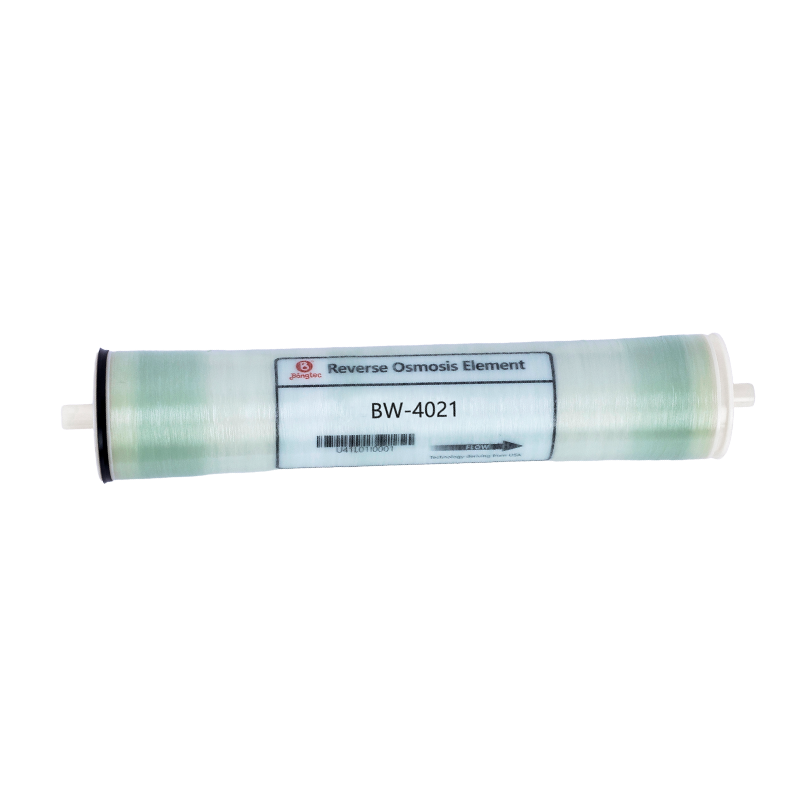
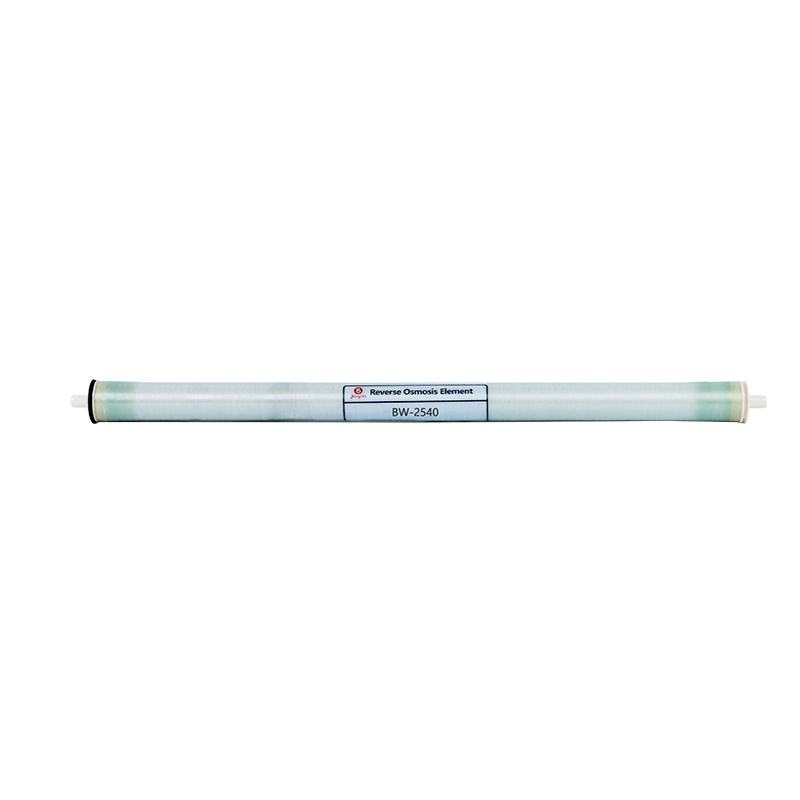
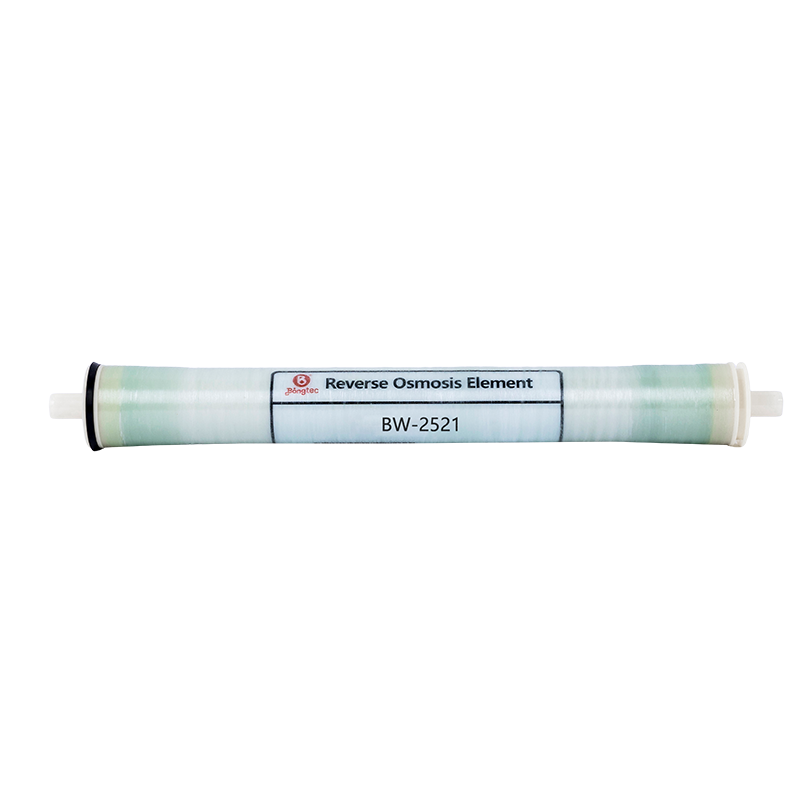
Brackish Water RO Membrane For Commercial is a specialized reverse osmosis membrane element designed for commercial applications, utilizing aromatic polyamide composite thin-film technology to treat brackish water with TDS concentrations ranging from 2,000 to 8,000 ppm. The product line covers both 4-inch and 8-inch standard configurations, widely applied in commercial drinking water systems, industrial pure water production, boiler feed water, and municipal water treatment. As a significant participant in the China Brackish Water RO Membrane sector, Jiangsu Bangtec Huachuang Sci-tech Co., Ltd. leverages technical expertise from a Chinese Academy of Sciences doctoral team to consistently deliver high-performance Brackish Water RO Membrane series for the global market.
Core Conclusion: Technical Positioning of Commercial Brackish Water RO Membranes
The core value of commercial-grade brackish water reverse osmosis membranes lies in achieving a balance between high salt rejection and high water flux at relatively low operating pressures. Under standard test conditions, the BW-4040 model achieves a stable salt rejection rate of 99.5% and a permeate flow exceeding 2,200 GPD at 225 psi operating pressure. The BW-8040 model delivers over 10,000 GPD under identical test conditions. For scenarios with fluctuating water quality or slight organic contamination, the Industrial BW-FR Ro Membrane effectively reduces fouling risks through a 34-mil feed spacer design, extending cleaning intervals.
Product Specifications and Technical Parameters
Commercial brackish water reverse osmosis membrane elements follow industry-standard dimensions to ensure compatibility with mainstream membrane housings. The table below summarizes typical model specifications and performance parameters, with test conditions of 2,000 ppm NaCl solution, 225 psi operating pressure, 25 degrees Celsius, pH 7.5, and 15% recovery rate.
| Model |
Active Membrane Area |
Permeate Flow (GPD) |
Stable Rejection |
Minimum Rejection |
Feed Spacer |
| BW-4040 |
78 ft² (7.2 m²) |
2,200 |
99.5% |
99.3% |
28 mil |
| BW-8040 |
400 ft² (37.2 m²) |
10,500 |
99.6% |
99.5% |
28 mil |
| BW-FR-4040 |
90 ft² (8.4 m²) |
2,200 |
99.5% |
99.3% |
34 mil |
| BW-FR-8040 |
400 ft² (37.2 m²) |
10,000 |
99.5% |
99.3% |
34 mil |
The permeate flow of individual membrane elements may vary within plus or minus 15%. The membrane material is polyamide thin-film composite, with a spiral-wound element configuration and FRP outer wrapping. Products from Jiangsu Bangtec Huachuang Sci-tech Co., Ltd. have achieved large-scale deployment across multiple industries including photovoltaics, lithium batteries, steel, electric power, chemicals, textile printing and dyeing, and coal chemical processing, with newly developed products reaching internationally leading performance benchmarks.
Operating Limits and Conditions
To ensure long-term stable operation of membrane elements, the following operating limits must be strictly observed. Exceeding these limits may result in performance degradation or warranty voidance.
| Parameter |
Limit Value |
| Maximum Operating Pressure |
600 psi (4.14 MPa) |
| Maximum Feed Water Temperature |
45°C (113°F) |
| pH Range During Continuous Operation |
3 - 10 |
| pH Range During Chemical Cleaning |
1 - 13 |
| Maximum Feed Water SDI15 |
5.0 |
| Residual Chlorine Concentration Limit |
Less than 0.1 ppm |
| Maximum Pressure Drop Per Element |
15 psi (1.0 bar) |
| Maximum Pressure Drop Per Vessel |
50 psi (3.4 bar) |
Selection Guide: 4040 versus 8040 Application Scenarios
In commercial brackish water reverse osmosis system design, the choice between 4040 and 8040 specifications directly impacts capital investment, maintenance convenience, and footprint. The following table outlines the core differences between the two configurations:
| Comparison Dimension |
BW-4040 |
BW-8040 |
| Element Dimensions |
4.0 inch x 40 inch |
8.0 inch x 40 inch |
| Permeate Tube Inner Diameter |
0.75 inch |
1.125 inch |
| Permeate Flow Per Element |
Approx. 2,200 GPD |
Approx. 10,500 GPD |
| Typical Applications |
Small commercial, laboratories, food service, pilot systems |
Municipal water supply, industrial BWRO, large commercial systems |
| Single Element Capacity |
Approx. 0.2 - 1.5 m³/h |
Approx. 1.5 - 4.0 m³/h |
| Housing Configuration |
Typically one element per 4-inch housing |
One to seven elements per housing |
| Investment Characteristics |
Lower initial investment, flexible layout |
Fewer housings, lower long-term operating costs |
For small commercial scenarios with daily treatment capacity below 5 m³, the BW-4040 is preferred due to lower initial investment and flexible modular expansion capabilities. When treatment capacity exceeds 20 m³/d, the BW-8040 demonstrates clear advantages in footprint and energy consumption through reduced housing and fitting quantities. System recovery rates are typically designed between 45% and 75%, requiring multi-stage arrangement to balance recovery and cross-flow velocity.
Technical Advantages of Fouling-Resistant Membrane Elements
The Industrial BW-FR Ro Membrane incorporates surface modification technology based on the standard BW series. The 34-mil feed spacer design increases channel space by approximately 21% compared to conventional 28-mil spacers, effectively reducing concentration polarization and contaminant deposition risks. Surface charge modification technology introduces specific functional groups, rendering the membrane surface hydrophilic and providing stronger repulsion against negatively charged colloids and organic matter.
In actual operational data, the BW-FR series in municipal wastewater reuse, surface water, and slightly organically contaminated water sources can extend chemical cleaning intervals to 1.3 to 1.5 times that of standard BW series. For environments where chlorine exposure is unavoidable, the FR series extends service life by approximately 30% compared to conventional polyamide membranes in chlorinated environments through surface topology optimization and increased cross-linking density.
Installation and Maintenance Essentials
Membrane element installation and maintenance directly affect system performance and membrane lifespan. The following are key operational guidelines:
- Before installation, confirm membrane element model, permeate tube interface dimensions, and housing compatibility. The brine seal should face the concentrate side.
- Tighten end caps evenly according to manufacturer-specified torque to avoid deformation from uneven loading.
- During initial startup, gradually increase pressure from low flow to avoid hydraulic shock.
- Permeate collected during the first hour of operation should be discarded and not used for drinking or food preparation.
- Once wetted, membrane elements must remain moist at all times. For extended shutdown periods, elements should be immersed in preservative solution.
- When normalized permeate flow decreases by 10% to 15%, or normalized differential pressure increases by 15% to 20%, or salt rejection decreases by 2% to 3%, chemical cleaning should be performed.
- Cleaning chemicals must be compatible with polyamide material. Avoid using oxidizing cleaning agents.
Quality Systems of Brackish Water RO Membrane Manufacturers
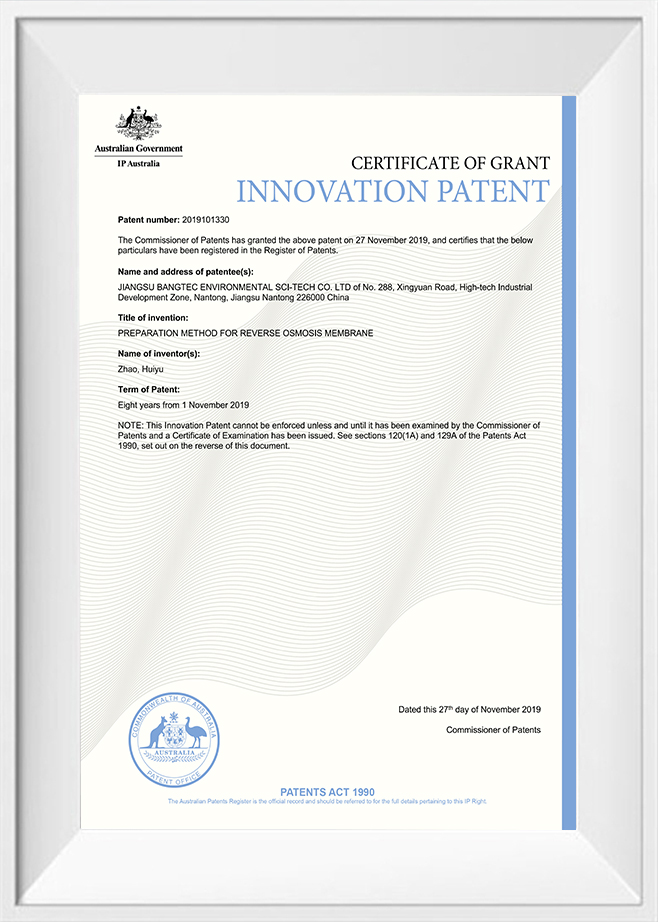
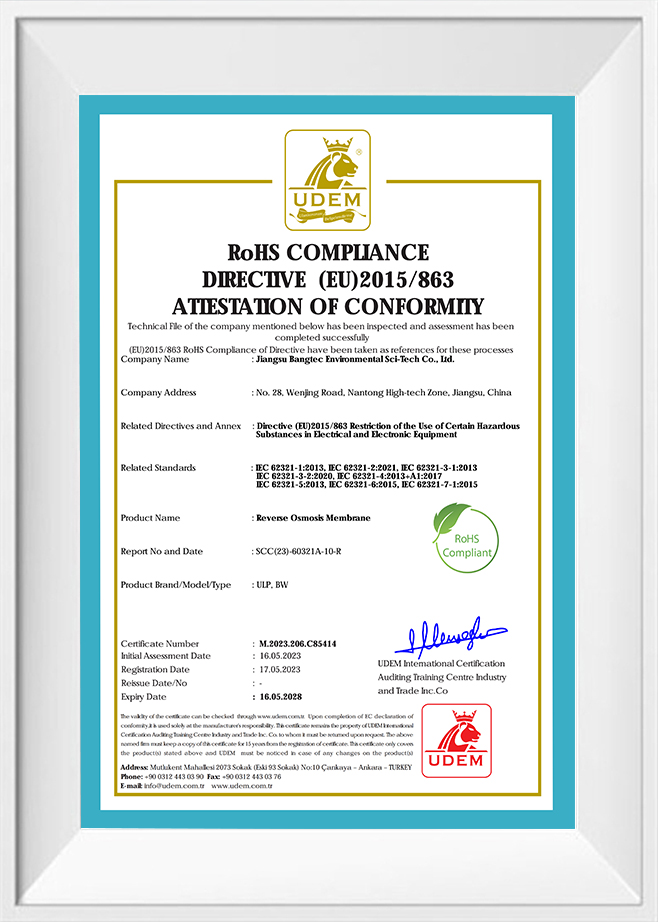
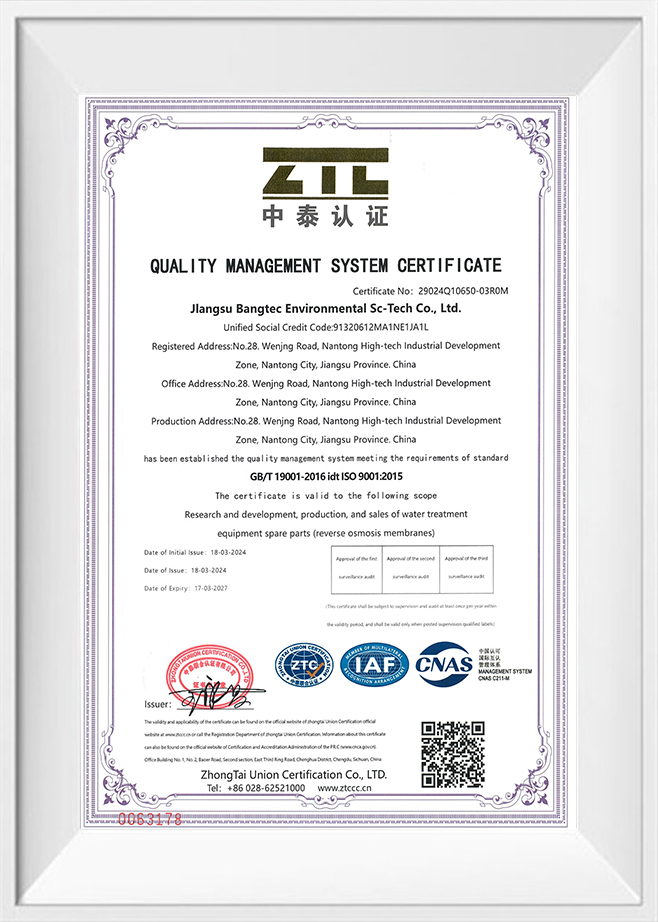
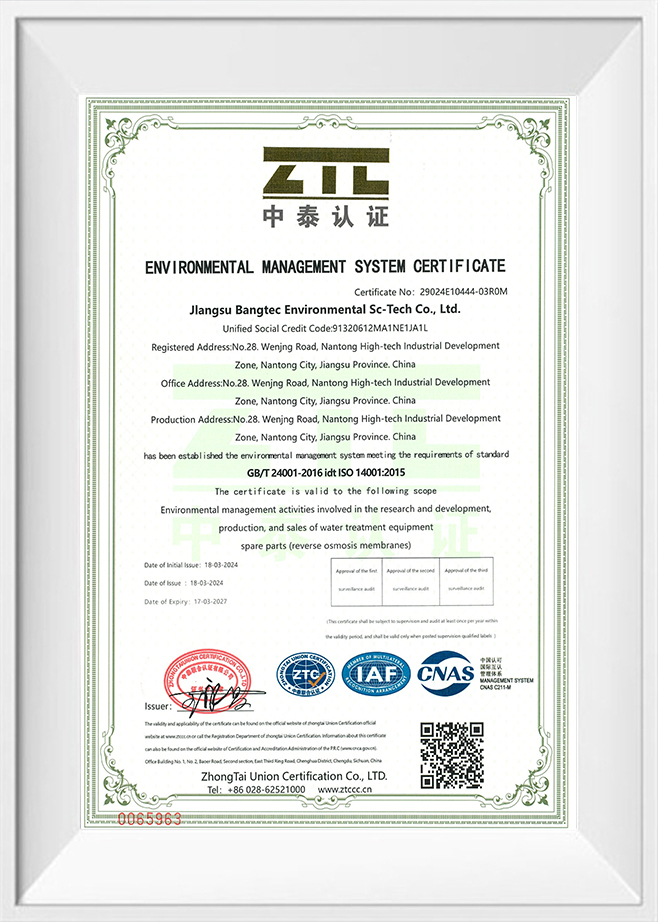
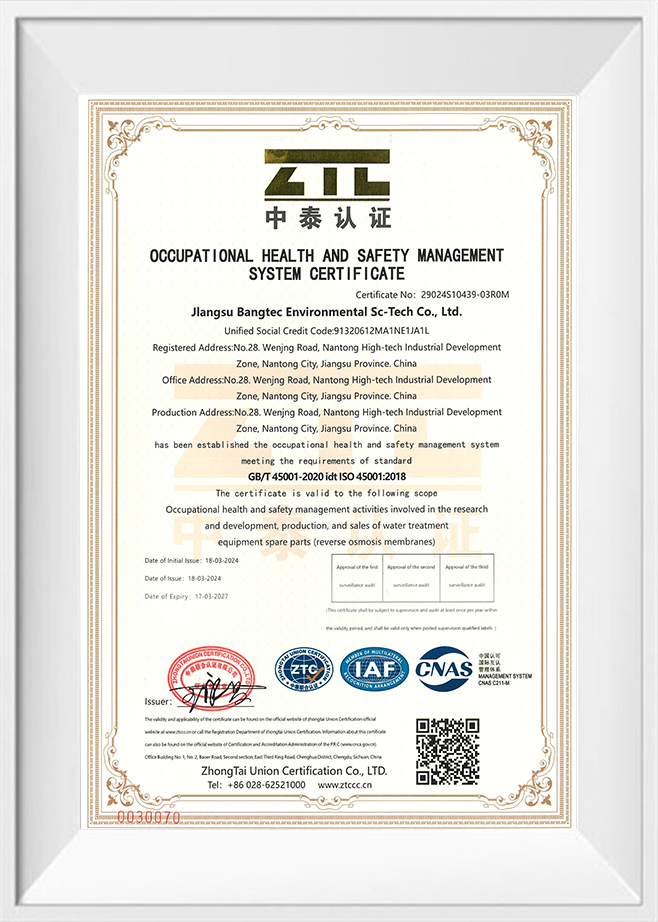
As a professional Brackish Water RO Membrane Supplier, Jiangsu Bangtec Huachuang Sci-tech Co., Ltd. has established a comprehensive quality management system. The company has obtained ISO9001 Quality Management System, ISO14001 Environmental Management System, and ISO45001 Occupational Health and Safety Management System certifications. Products carry CE certification and Jiangsu Provincial Water-Related Approval. The company holds multiple domestic and international invention patents and maintains three overseas R&D institutions for continuous new product development. Membrane elements are vacuum-sealed packaged with 1% sodium bisulfite preservative solution. Storage temperature should remain below 35 degrees Celsius, avoiding direct sunlight and freezing conditions.
Frequently Asked Questions
What is the primary difference between commercial brackish water RO membranes and residential RO membranes
Commercial-grade membrane elements significantly exceed residential membranes in active area, permeate flow, and pressure rating. The BW-4040 offers approximately 78 ft² of active area with over 2,000 GPD permeate flow, while residential 1812-type membranes typically deliver only 50 to 100 GPD. Commercial membranes feature FRP outer wrapping and can withstand maximum operating pressures up to 600 psi, suitable for continuous industrial operation.
How should I choose between BW series and BW-FR series membranes
For stable water sources with SDI below 3, the standard BW series provides sufficient performance at lower cost. When feed water contains slight organic contamination, colloids, or SDI between 3 and 5, the BW-FR series is recommended. The 34-mil feed spacer design reduces fouling rates and decreases cleaning frequency and chemical consumption.
What is the recommended replacement cycle for membrane elements
Under proper operation and regular maintenance, commercial brackish water reverse osmosis membranes typically last 2 to 3 years. Actual replacement cycles depend on feed water quality, operating pressure, cleaning frequency, and chemical selection. Quarterly recording of normalized permeate flow, differential pressure, and salt rejection is recommended to establish performance trend records for predicting replacement timing.
What is the chlorine tolerance limit for brackish water RO membranes
Polyamide material is sensitive to free chlorine. Residual chlorine concentration during continuous operation must be controlled below 0.1 ppm. While membrane elements exhibit some tolerance to short-term exposure to low chlorine concentrations, sustained exposure causes irreversible oxidative damage. Pretreatment systems should include activated carbon or sodium bisulfite dechlorination units with ORP online monitoring instruments.
What system recovery rate is considered reasonable
Commercial brackish water reverse osmosis systems are typically designed with recovery rates between 45% and 75%. Excessive recovery increases scaling risk on the concentrate side, while insufficient recovery wastes water resources. Specific designs should consider feed TDS, hardness, alkalinity, and temperature parameters, achieving optimal balance through antiscalant dosing and multi-stage arrangement.


 EN
EN  عربى
عربى