
Content
Two quotes land on the same desk. One is a 2 m³/h reverse osmosis skid; the other is a deionized water service contract with monthly resin exchanges and a conductivity guarantee. Both suppliers say "purified water", and on paper the polished specifications can look almost identical. A year later one plant is changing cartridges on a schedule and paying for concentrate disposal, while the other is paying per cubic metre for regenerated resin because its feed water was never meant to touch an ion exchange bed directly.
That gap is not marketing. Reverse osmosis and deionization remove impurities by different mechanisms, and the mechanism decides which one belongs in front of the other.
The working rule is simple: RO is a bulk separator, DI is a final polish. RO removes 95–99.5% of dissolved ions at a cost that scales with pressure, membrane area and pumping energy. DI removes what is left down to almost nothing, at a cost that scales with the number of ions passing through the resin bed.
Reverse osmosis pushes pressurised feed water across a semipermeable polyamide membrane. Water passes; dissolved salts, colloids, bacteria and most large organic molecules are rejected and leave in the concentrate stream. Brackish water elements typically run at 10–15 bar, seawater elements at 55–70 bar, and rejection of ions such as sodium, chloride, sulphate and calcium sits between 95% and 99.5% per pass.
Deionization is a chemical process. Cation resin charged with hydrogen ions swaps for sodium, calcium and magnesium; anion resin charged with hydroxide swaps for chloride, sulphate and nitrate. The result is water with essentially no ionised species left, which is why resistivity climbs towards 18.2 MΩ·cm at 25 °C instead of stalling at a few hundred thousand ohm-centimetres.
| Item | Reverse osmosis | Deionization |
|---|---|---|
| Driving force | Pressure across a membrane | Ion exchange onto H+ and OH− resins |
| Removes well | 95–99.5% of ions, colloids, bacteria, endotoxins, organics above roughly 200 Da | Essentially all ionised species, including weak acids such as silica and carbon dioxide |
| Passes through | Dissolved gases (CO2, NH3), small uncharged molecules, part of the boron at neutral pH | Bacteria, particles, pyrogens and uncharged organics |
| Typical outlet | 5–50 µS/cm from brackish feed | Below 1 µS/cm; up to 18.2 MΩ·cm with polishing |
| Waste stream | Concentrate, 25–50% of feed | Acid and caustic regenerant, or EDI reject |
| Consumables | Elements (3–5 years), cartridges, antiscalant, energy | Resin, regenerant chemicals, or electricity for EDI |
The two are stages, not rivals. Electrodeionization makes the point plainly: EDI stacks are only specified on RO permeate, because their resin would be destroyed by the hardness and chlorine in raw water.
Carbon dioxide passes the membrane, forms carbonic acid in the permeate and then consumes anion resin capacity downstream. That is why permeate conductivity is a poor predictor of DI run length: a 20 µS/cm permeate carrying 15 mg/L CO2 can exhaust a polisher faster than a 30 µS/cm permeate with none. Low-molecular-weight solvents and short-chain alcohols also pass, and boron rejection only improves once pH is raised above about 10.
Resin does not filter. Bacteria, endotoxins, resin fines and uncharged organics travel straight through a bed, and the bed itself can become a biofilm reactor on warm water. A Type I loop therefore needs ultrafiltration at 0.2 µm, UV at 185 nm for TOC oxidation, and continuous recirculation rather than a dead-end tank.
DI water has almost no buffer capacity, so it dissolves copper, galvanised steel and even mild steel piping within months. Trace chloride in a polished loop will pit 304 stainless. Specify PP, PVDF or 316L, avoid dead legs, and keep the loop short.
Compare the two technologies by the parameters your process actually controls, and always at the same temperature, because resistivity is quoted at 25 °C.
| Parameter | RO permeate | DI (Type II) | Polished DI (Type I) |
|---|---|---|---|
| Conductivity | 5–50 µS/cm | 0.1–1 µS/cm | 0.055 µS/cm |
| Reactive silica | 0.2–1 mg/L | Below 10 µg/L | Below 3 µg/L |
| TOC | 0.5–2 mg/L | 50–200 µg/L | Below 10 µg/L with UV and UF |
| Hardness as CaCO3 | Usually below 1 mg/L | Below 0.1 mg/L | Not detectable |
| Bacteria | Largely rejected | Beds can support growth | Below 1 CFU/100 mL with UF and UV |
Resin capacity is the whole economics. A 25 L mixed bed holds roughly 12–25 equivalents of usable exchange capacity. Feed at 500 mg/L TDS carries about 8.5 equivalents per cubic metre, so the bed is spent after roughly 1.5–3 m³. Drop the feed to a 25 mg/L RO permeate and the same bed delivers twenty times more water. That single ratio explains why standalone DI is only rational for small, intermittent demand.
On the RO side, energy for brackish water sits at about 1–4 kWh/m³, elements are replaced every three to five years, and recovery of 50–75% means a concentrate stream that may cost more to discharge than the electricity does. Add the hidden DI costs: regeneration chemicals, neutralisation, resin replacement and exchange fees.
Where feed TDS is low and pumping energy dominates the operating budget, low-pressure element designs pay back quickly by running at reduced net driving pressure.
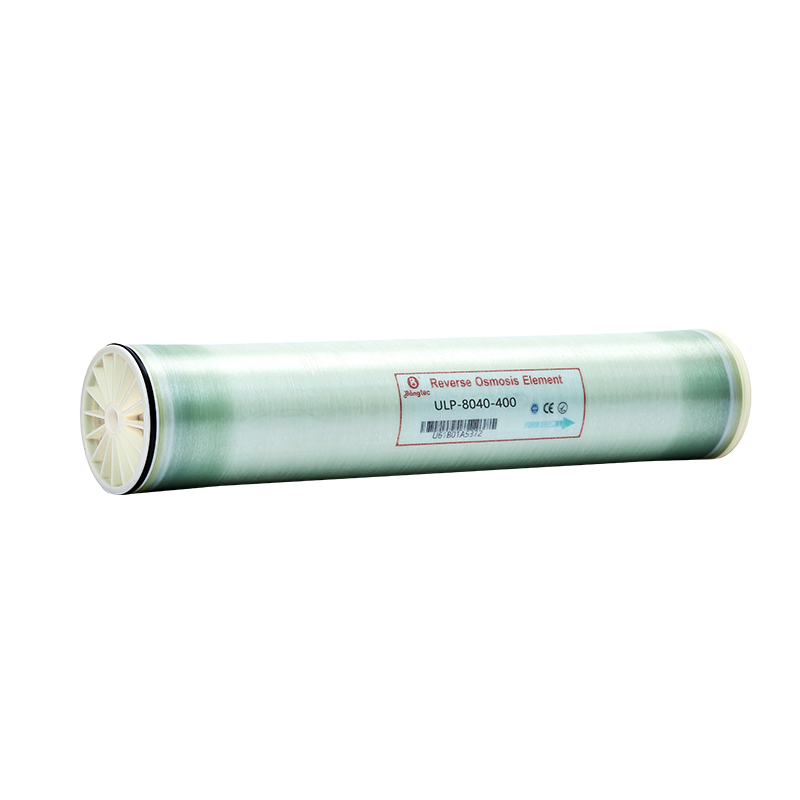 Ultra-Low Pressure RO Membrane Element ULP-8040-400Low-pressure polyamide element for surface and groundwater below 2000 ppm, offering high flux and 99.3% stable rejection to reduce pumping energy.View Product →
Protect the membrane first. Free chlorine must be removed, because polyamide tolerates only trace continuous oxidant; silt density index should stay under 5; a 5 µm cartridge guards the element; antiscalant or pH adjustment controls calcium carbonate and sulphate scaling; and flux must be corrected for temperature, since output moves roughly 2–3% per °C.
Element choice follows the feed. Brackish water elements cover the 1,000–5,000 mg/L range and are the default for industrial and commercial duty. Fouling-resistant versions suit wastewater and high-organics streams, seawater elements handle high pressure, and nanofiltration is the right call when partial softening or monovalent passage is wanted rather than full demineralisation.
Bangtec manufactures membrane sheets, elements and the systems built around them, with roughly 15 million m² of membrane output per year; the broader capability set is summarised on the company profile page.
Below about 0.5 m³/h, a four-stage RO/DI skid is usually the answer: sediment filter, carbon block, a small RO element in 1812 or 2012 format, then a mixed bed cartridge, optionally with UV. Watch for TDS creep, the spike of dissolved solids that crosses the membrane after idle periods; a flush valve or an automatic divert protects the resin. Size the DI cartridge by daily ion load rather than by flow rate, and check it colourimetrically rather than by guesswork.
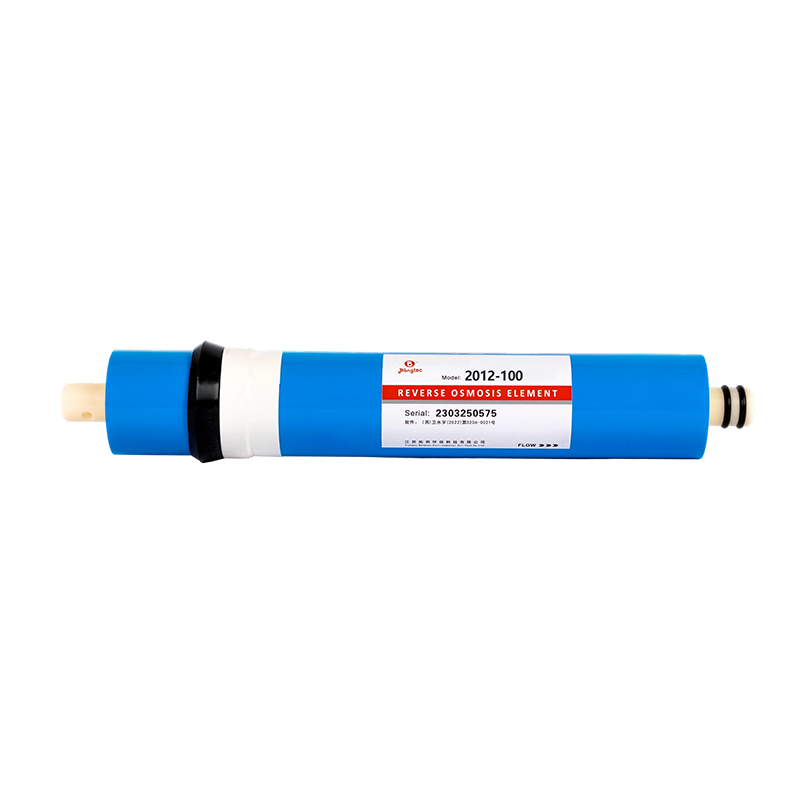 RO-2012-100 Domestic Reverse Osmosis Membrane ElementStandard 2012-series home RO cartridge producing 100 GPD with about 97% salt rejection for household purifiers and small RO systems.View Product →
For commercial-scale trains, the selection factors for commercial RO membranes are worth reviewing before the quotation stage.
No. RO water still contains a few percent of the original dissolved salts, plus dissolved gases. DI water has had ionised species removed almost completely, but can carry bacteria and uncharged organics.
Only where the method tolerates it. Glassware rinsing and some buffer preparation are fine; trace analysis, cell culture and HPLC mobile phases generally are not.
Because it has no buffering and almost no ionic strength, it pulls ions out of metal surfaces. Copper, galvanised steel and mild steel are unsuitable materials for a polished loop.
It is not harmful in small amounts, but it lacks minerals and is not microbiologically stable in a storage tank. Potable systems usually blend or remineralise rather than distribute pure DI.
Two, if the specification is measured in resistivity or µg/L. One, if the specification is measured in mg/L, hardness removal or volume reduction.
RO and DI are sequential tools. RO removes the bulk of the salt load at low cost per cubic metre and protects everything downstream; DI delivers the final ionic purity, but only cheaply when the water reaching it is already clean.
Decide with feed chemistry, the real point-of-use specification and the concentrate route in hand. Those three inputs settle the deionized water versus RO question faster than any brochure comparison.
Popular Products

+86-513 8659 8187
+86-189 6299 3952
No.28 Wenjing Road, Nangtong High-tech Industrial Development Zone, Jiangsu Province, China


 EN
 عربى