
Content
The answer is yes: a healthy reverse osmosis membrane removes nanoplastics, and it does so with more margin than almost any other drinking-water technology. The dense polyamide layer inside an RO element has an effective pore size in the range of a few tenths of a nanometre. Nanoplastics, whether engineered or shed by degrading plastic, sit roughly between 1 and 100 nm. Size exclusion alone gives RO one to two orders of magnitude of headroom.
The practical limit is not the membrane. It is everything downstream of it. Seals, O-rings, end caps, pretreatment cartridges, product tubing and the final faucet all sit on the permeate side. Any of them can contribute particles if they age out or are badly specified. So the useful question is not whether reverse osmosis filters nanoplastics, but whether a given system design preserves the membrane's rejection all the way to the point of use.
RO does not rely on sieving alone. Three mechanisms work together, which is why it stays effective at a scale where most media filters stop performing.
Placed alongside other common processes, the gap in resolution becomes obvious.
| Treatment stage | Typical pore size | Expected nanoplastic (1–100 nm) removal |
|---|---|---|
| Granular or carbon block | Adsorptive, not size-based | Partial; depends on surface chemistry and contact time |
| Microfiltration | 0.1–10 µm | Very low for nanoplastics; effective on larger microplastics |
| Ultrafiltration | 1–100 nm | Variable; follows the particle size distribution |
| Nanofiltration | ~1 nm | High for most nanoplastics, partial for the smallest fraction |
| Reverse osmosis | ~0.1–1 nm | Highest of the commonly deployed options |
One caveat before moving on: a smaller pore does not automatically deliver cleaner water. A cartridge that is not seated properly, or a housing with a failed seal, lets water bypass the media entirely. The same is true of a membrane element with a leaking end seal. That is where the next section starts.
The membrane performs as specified. The losses usually happen around it. Five situations account for most of what shows up in a glass.
When specifying a system, walk these five points against the supplier's drawings. A supplier who can describe seal geometry, end-plate design and permeate-side materials in detail usually understands how those parts behave over a service life.
Rejection is designed in, not bought in. These parameters influence nanoplastic retention more than any single datasheet figure.
Selection work is more reliable when membrane area, flux margin and the cleaning regime are calculated together rather than judged on initial flow alone. The trade-offs between flux, recovery and feed conditions are set out in our guide to RO membrane selection factors, which is worth reading before fixing a specification.
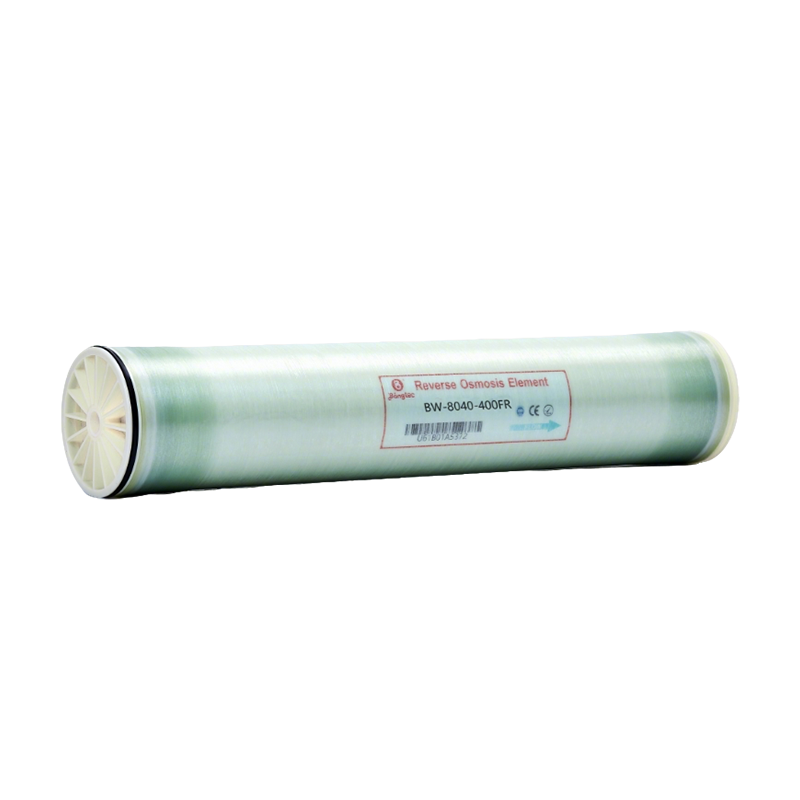 Fouling-Resistant BW-8040-400FR RO Membrane ElementA 400 ft² fouling-resistant element with 99.7% stable rejection for complex feedwaters below 10,000 ppm TDS, useful when comparing flux margin and cleaning needs.View Product →
The rejection mechanism is identical at every scale. What changes is where things go wrong.
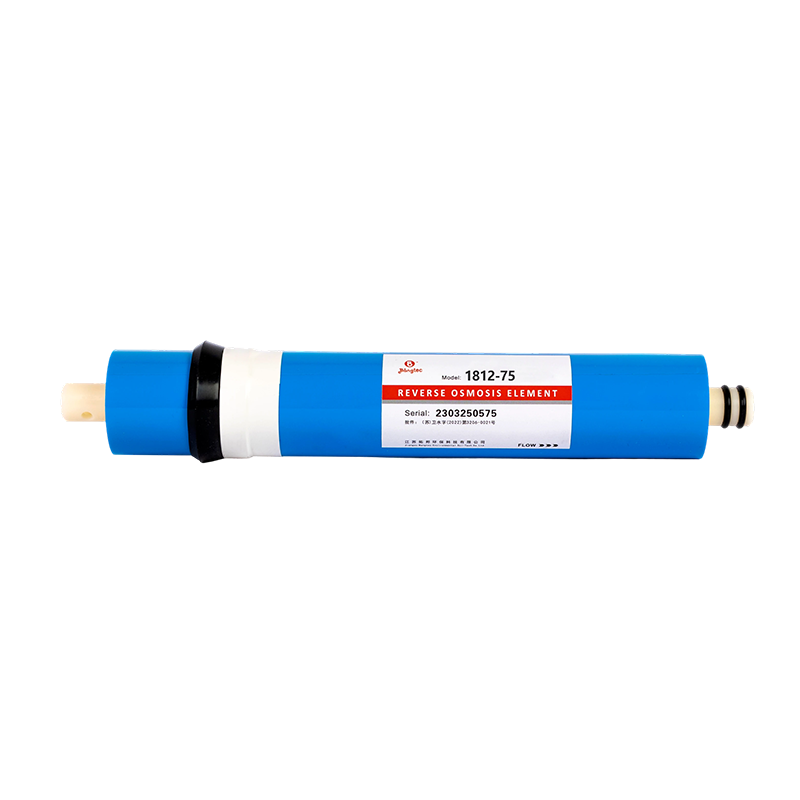
Home. Elements from 1812 through 3413 sit under a sink or inside a countertop unit, usually followed by a pressure tank and a length of hose. The tank bladder and the hose are the parts worth scrutinising; a tankless design removes one of them from the chain. A typical example in the 3012 format is the RO3012800 element, widely used where cabinet space is tight.
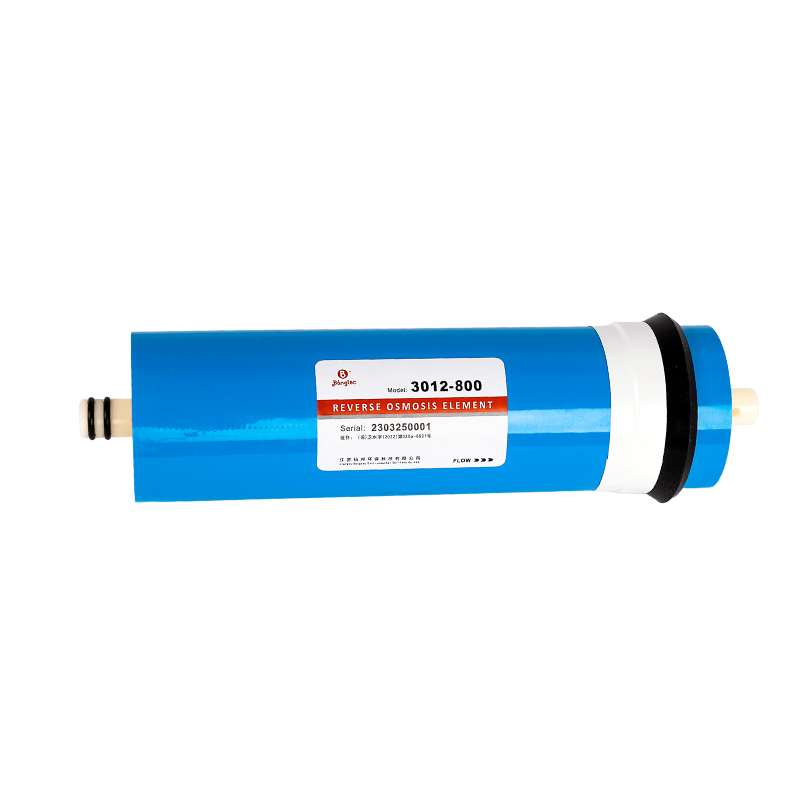 RO-3012-800 High-Flow Domestic RO Membrane ElementAn 800 GPD, 3.0" x 12" domestic element with 95% stable rejection, suited to compact under-sink systems needing higher continuous output.View Product →
Commercial. The 2521, 2540 and 4021 formats serve food service, small laboratories and building drinking-water points, where draw-off is intermittent. Start-stop cycling stresses end seals harder than continuous operation does, so the way the end plate is fixed deserves a look.
Industrial. 8040 elements sit inside pressure vessels, often several in series. The most common problem here is not single-element performance but interconnectors between vessels and the vessel end-plate seals. One leak degrades a whole stage at once, so troubleshooting works stage by stage rather than element by element.
Whatever the project size, these points feed directly into the particle level at the outlet.
The first two items largely decide whether the membrane works as designed; the rest decide whether the system still performs the same way in year five. On the manufacturing side, membrane sheet consistency, rolling accuracy and factory testing set the floor for element performance, and our membrane production and quality control page covers how those steps are controlled.
No process can promise 100 percent. A healthy element with intact seals retains the great majority of nanoplastics, and most of what remains originates downstream of the membrane rather than through it.
The membrane itself is stable in normal service. The parts to watch are rubber seals, plastic tubing and cartridges. Flushing a newly installed system properly reduces this contribution substantially.
Nanofiltration, with pores around 1 nm, achieves high rejection of most nanoplastics but leaves a gap at the smallest end of the distribution. If the goal is minimum particle risk alongside dissolved-ion removal, RO is the more suitable choice; where mineral retention and lower energy matter more, nanofiltration is a reasonable trade.
No. Boiling inactivates microorganisms, but plastic particles do not disappear with heat, and evaporation concentrates whatever remains in the pot.
Reverse osmosis retains nanoplastics because of what the membrane is, but how much reaches the glass depends on seals, tubing, pretreatment and operating discipline. Treating those as part of the specification, rather than as accessories, is what turns a good membrane into a reliable result.
For a specific water quality, share the feed analysis, the intended use of the permeate and the cleaning constraints together, and the answer arrives faster than starting from a question about which element is best.
Popular Products



+86-513 8659 8187
+86-189 6299 3952
No.28 Wenjing Road, Nangtong High-tech Industrial Development Zone, Jiangsu Province, China


 EN
 عربى