
Content
When a purified water loop fails requalification, the investigation almost always ends at the reverse osmosis skid. Not because RO is the weakest step in the train, but because it is the only step asked to remove 95 to 99 percent of everything dissolved in the feed, while sitting between a pretreatment train it cannot control and a polishing step that tolerates almost no hardness carryover at all.
So the conclusion first: pharmaceutical water reverse osmosis is a specification problem before it is a hardware problem. Fix the water quality you must hold at the point of use, then size flux, recovery, array configuration and sanitization backwards from those limits. Systems built around a catalogue element rather than a validated water specification are the ones that generate deviation reports two years after handover.
United States Pharmacopeia chapter 1231 describes purified water as water obtained by a suitable process that meets three numeric limits: a conductivity specification, total organic carbon of no more than 0.5 mg/L, and a bioburden of no more than 100 CFU/mL. There is no bacterial endotoxin limit on purified water, which is what separates it from Water for Injection.
Note the word suitable. The monograph does not name a membrane, a flux or a recovery; it names a result. That leaves the design to the engineer, and it explains why two plants chasing the same pharmacopoeial target can run completely different RO trains.
Reverse osmosis does the bulk of the work. A polyamide element rejects more than 99 percent of dissolved ions on a nominal sodium chloride test, along with most organics above roughly 200 daltons, while also acting as a physical barrier for bacteria and endotoxin. What it does not do is destroy anything. Rejected salt, organics and microorganisms are pushed into the concentrate, which makes the concentrate side of an RO an excellent place for biofilm to grow. A pharmaceutical RO system therefore needs a sanitization regime, not just a cleaning regime.
One practical consequence: on most municipal or softened well waters, a single pass will not hold the purified water conductivity test with margin, especially when feed temperature drops in winter. Two-pass RO, or a single pass followed by electrodeionization, is the normal route. Treat the first pass as the bulk remover and the second barrier as the guarantee.
Most validated purified water systems follow the same sequence. The difference between a skid that runs quietly for years and one that fights you every quarter is almost always in pretreatment and instrumentation, not in the membrane model number.
| Stage | What it controls | Detail that decides performance |
|---|---|---|
| Multimedia or ultrafiltration pre-treatment | Suspended solids, silt, colloids | Silt density index below 3 and turbidity below 1 NTU entering the cartridge filters |
| Softening or antiscalant dosing | Hardness and carbonate scaling | Hardness in the concentrate held near zero, or LSI kept negative by dosing |
| Activated carbon or bisulfite | Free chlorine and chloramine | Residual free chlorine kept under 0.1 mg/L, since polyamide is destroyed by oxidation |
| Cartridge filtration at 5 microns | Particles and carbon fines | Changed on differential pressure, not on a calendar |
| First-pass RO | Bulk ions, organics, microbial load | Average flux held in the 10 to 17 LMH band on clean surface water |
| Second-pass RO or EDI | Residual ions down to purified water conductivity | Second-pass permeate typically 1 to 5 microsiemens per centimetre feeding the polisher |
| UV at 185 and 254 nm plus final ultrafiltration | TOC and microbial control in the loop | Positioned after the RO, because UV cannot penetrate a membrane |
| Distribution loop | Circulation and biofilm control | Turbulent flow at all times, including nights and weekends |
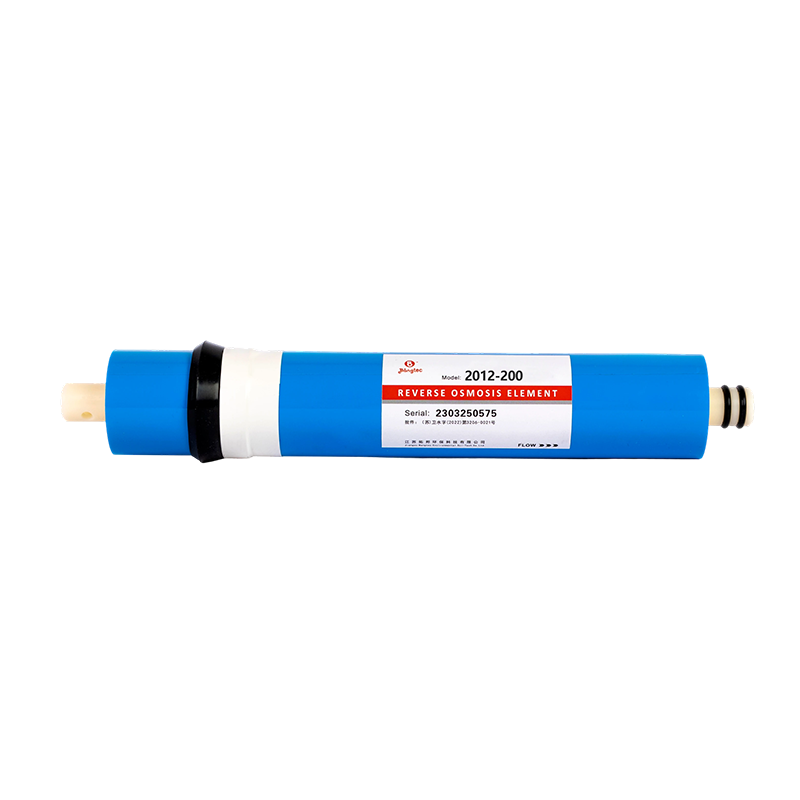
Membrane class follows the feed. Municipal and softened well water suits standard brackish water elements, the workhorse choice for a pharmaceutical train; feeds carrying high silica, iron or organic loading need a fouling-resistant element with a wider cleaning window.
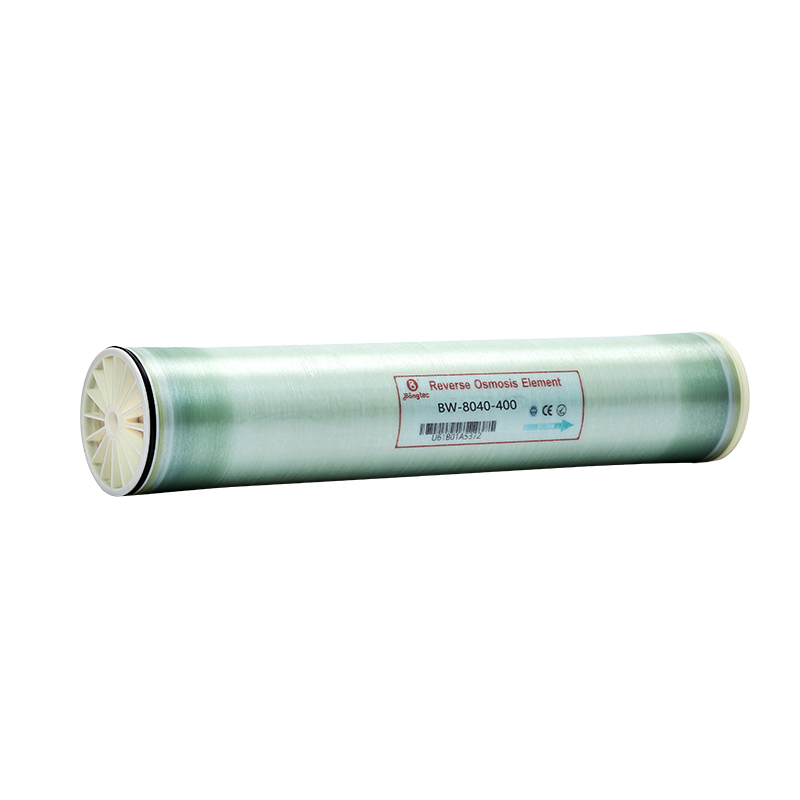 BW-8040-400 Brackish Water RO Membrane ElementStandard brackish water element for municipal and softened well feeds; 400 ft2, 10,500 GPD, and 99.7% rejection suit pilot or small production arrays.View Product →
Element size matters too. A 4,040 element in a two-element vessel is a common pilot and small-production configuration, while 8,040 elements carry the load in a 10 to 50 cubic metre per hour pharmaceutical array. Mixing sizes in one array is technically possible, but it complicates normalization, because specific flux per element differs.
Membrane permeability is a function of temperature. A widely used approximation is a 3 percent change in required pressure for every degree Celsius away from 25 degrees. Feed at 10 degrees therefore needs roughly 55 percent more pressure than the same water at 25 degrees, and winter operation is when many systems first fail to make rated flow. Temperature also moves rejection the other way: warmer feed passes more salt, so a system that gains capacity in summer loses margin on conductivity.
Approximation based on a 3 percent pressure change per degree Celsius from the 25 degree reference used for element normalization. Confirm against the manufacturer's correction table before sizing.
The design consequence is straightforward: specify membrane area for the coldest feed of the year and specify the polishing stage for the warmest. Doing one without the other is how a validated system ends up with a seasonal deviation.
Pressure is what you apply; flux is what the membrane actually sees per unit area, and it is what drives concentration polarization and organic attachment. For clean surface water, an average flux of 10 to 17 litres per square metre per hour is a reasonable design band; for wastewater or high-silica feeds, stay under 10. Check the beta ratio as well: the last element in a pressure vessel should not pass more than 1.2 times the flow of the first.
Water softened to near-zero hardness often supports 75 percent recovery in a single pass. The limit appears when silica, calcium sulfate or barium sulfate approaches saturation in the concentrate. Silica is the one that catches people out: softening does not remove it, its solubility is temperature dependent, and once it deposits it is very hard to clean. Where silica is a risk, a fouling-resistant element with a modified feed spacer and a wider cleaning pH range gives you more operating room.
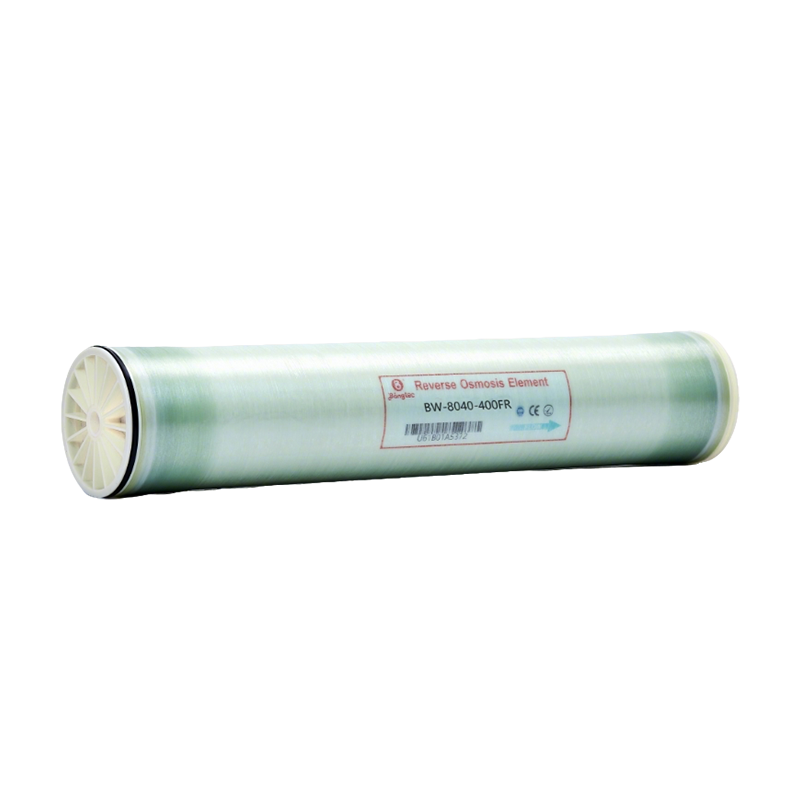 BW-8040-400FR Fouling Resistant Brackish Water RO ElementFouling-resistant 400 ft2 element for surface water, wastewater, and brackish feeds where silica or organic loading calls for wider cleaning latitude and stable 99.7% rejection.View Product →
Choose between hot water at 80 to 85 degrees and chemical sanitization before the elements are ordered. Heat-sanitizable elements and their interconnectors are a different product with different temperature limits, and retrofitting a standard element into a hot-water-sanitized skid is a warranty problem waiting to happen.
Pharmacopoeial water is judged on data. That means calibrated conductivity cells at each stage, with temperature measurement at each cell, plus a TOC analyser on the loop and sample valves that can themselves be sanitized. A system that can only report loop conductivity cannot tell you whether a shift came from the feed or from the membrane. There is also an energy decision hiding here: where feed is warm and the array is already generously sized, a low-pressure high-rejection element can hold the same permeate quality at a lower net driving pressure, which shows up directly on the pumping energy bill.
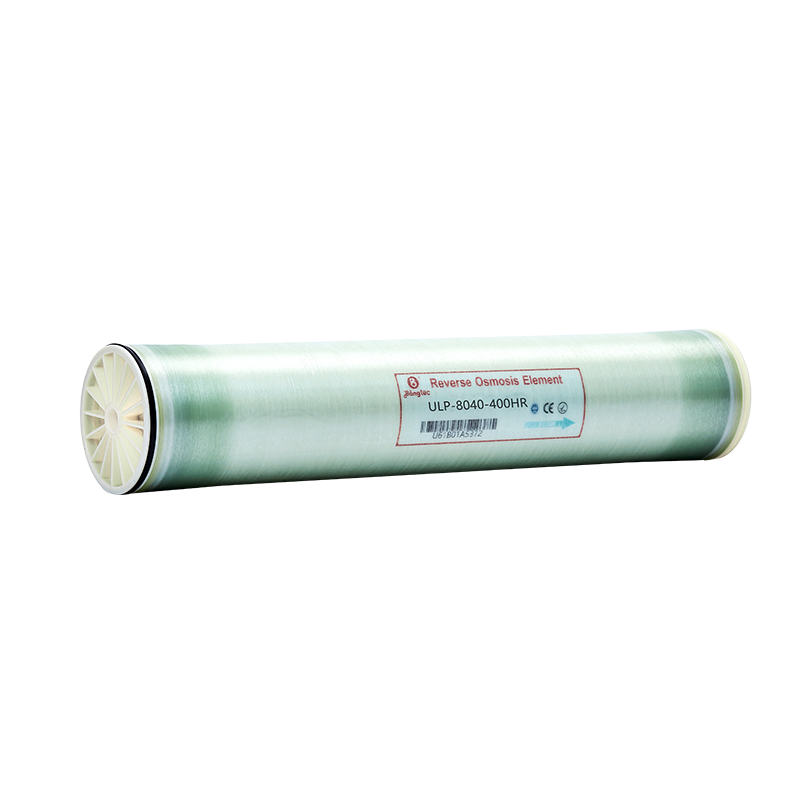 ULP-8040-400HR Ultra-Low Pressure RO Membrane ElementUltra-low pressure 400 ft2 element with 99.5% rejection and 10,500 GPD, suited to warm, generously sized pharmaceutical or pure-water arrays seeking lower pumping energy.View Product →
Most performance losses fall into a small number of categories, and nearly all of them are visible in normalized data before they appear as a failed conductivity reading. Track normalized permeate flow, normalized salt passage and pressure drop per stage. A 10 to 15 percent shift in normalized flow, or a doubling of element pressure drop, is a signal to investigate rather than to clean.
Illustrative split for a two-pass purified water system. Actual shares move with feed temperature, recovery ratio and local electricity price.
Membrane elements look like a commodity and do not behave like one. The differences that matter are in wet testing, traceability, and whether the supplier will look at your array design rather than only at your purchase order.
The last question matters more than it appears. A membrane manufacturer that also engineers water treatment systems will usually flag an unrealistic flux or recovery before the pressure vessels are built. Bangtec manufactures its own elements and designs systems around them, with a stated portfolio of more than 50 patents and a membrane team with GE and Chinese Academy of Sciences backgrounds; you can read more on the company background page or take the factory tour covering the automated line behind its stated capacity of 15 million square metres per year.
It can, on a low-TDS, softened, temperature-stable feed, usually with a polishing step such as EDI behind it. Most new systems specify two-pass RO or RO plus EDI, because the conductivity test has to be met at the worst feed condition of the year, not the average.
Nominal rejection for brackish water polyamide elements sits in the 99 to 99.7 percent band under test conditions. In service, real rejection depends on feed composition, temperature, recovery and element age; a second pass typically lifts overall system rejection past 99.5 percent.
Three to seven years is a common range with good pretreatment and a genuine sanitization schedule. The replacement trigger should be normalized performance that does not recover after cleaning, not a calendar date.
A complete ion analysis, silica, hardness, alkalinity, total organic carbon, silt density index, iron and manganese, free chlorine, and the full annual temperature range. A single summer sample is not enough to design for winter, and winter is where most designs are tested.
Pharmaceutical water reverse osmosis is judged by what the loop holds at the point of use on the worst day of the year: after a cold snap, after a carbon bed change, after a long shutdown. Design the array for the coldest feed, the polishing stage for the warmest, and the sanitization regime around the bioburden your own trend data shows. Element model, vessel count and pump curve all follow from those three decisions, and nothing downstream can rescue them if they were made the other way round.
Popular Products

+86-513 8659 8187
+86-189 6299 3952
No.28 Wenjing Road, Nangtong High-tech Industrial Development Zone, Jiangsu Province, China


 EN
EN  عربى
عربى