
Content
A large logic fab can draw millions of gallons of water a day, and almost none of it leaves as product. A substantial share is consumed in the ultrapure water loop, where reverse osmosis sits at the front end and carries the heaviest dissolved-solids load. When that stage drifts, everything behind it — EDI, polishing mixed beds, UV, final filters — pays the price in resin exhaustion and rejected wafers.
The short answer on selection: for inland fabs on municipal or well water, an 8-inch brackish water RO element in a two-pass train, with dechlorination and antiscalant dosing, will deliver the feed quality EDI needs. Coastal plants on seawater feed need a seawater element in the first pass and a brackish element behind it. Plants running on reclaimed water should start from fouling-resistant elements with wider feed spacers, not from the cheapest standard element.
The rest of this article explains why those choices hold, where they break down, and which numbers to check before a purchase order is signed.
UPW specifications are unforgiving by design: 18.2 MΩ·cm resistivity at 25 °C, total organic carbon in the low parts-per-billion range, silica below roughly 1 ppb, boron and metals measured in parts per trillion, and dissolved oxygen below 1 ppb after degassing. No RO element achieves that alone. The job of reverse osmosis is to strip 97 to 99 percent of the dissolved ions so EDI and polishing mixed beds can finish the last two orders of magnitude without regenerating constantly.
Two parameters cause most of the trouble:
Feed chemistry decides the element family. The table below maps common semiconductor plant scenarios to the membrane type that fits, along with the design detail that usually gets underestimated.
| Feed source | Duty in the train | Membrane type | Design notes |
|---|---|---|---|
| Municipal or well water, TDS 300–1,500 mg/L | First-pass bulk desalination | Brackish water RO (BW series) | 15–17 bar, 75–85 percent recovery with antiscalant; 8040 elements as the standard building block |
| Low-TDS, well-pretreated, energy-sensitive | First pass with reduced pumping cost | Ultra-low-pressure RO | Lower net driving pressure, but requires minimum concentrate flow per element to avoid fouling |
| Seawater, coastal site | First pass on high-salinity feed | Seawater RO | 55–70 bar; a second brackish pass is normally needed to reach UPW inlet quality |
| Reclaimed water with high organic load | First pass with frequent cleaning cycles | Fouling-resistant RO | Wider feed spacers, smoother surface, higher cleaning tolerance |
| Hardness-dominated feed | Selective rejection ahead of EDI | Nanofiltration | Preferential rejection of divalent ions; performance is strongly pH-dependent |
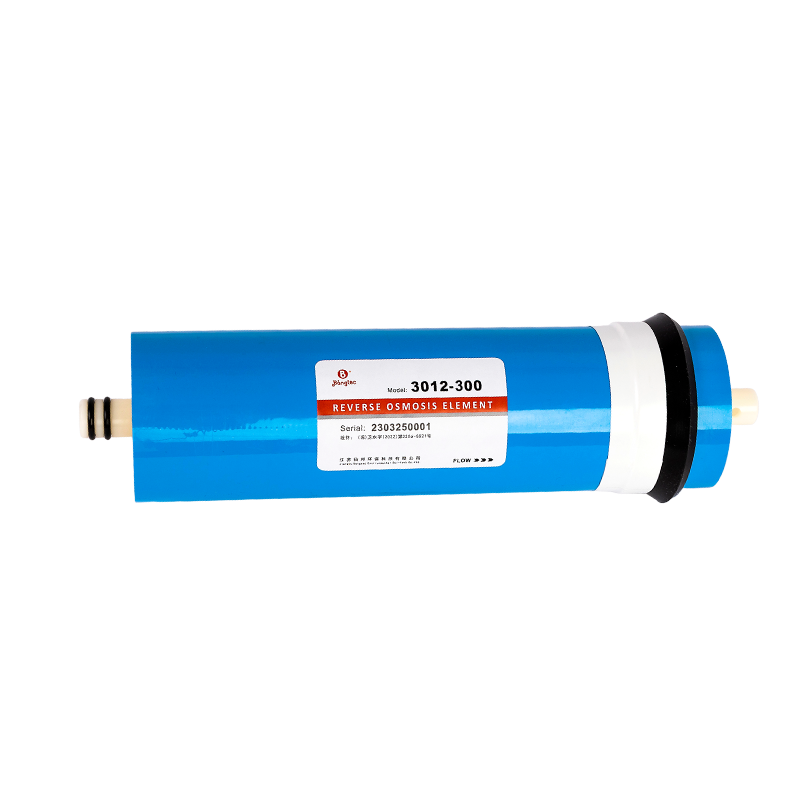
Most inland fabs standardize on 8-inch brackish water elements with about 400 square feet of active area, rated at 2,000 mg/L NaCl, 15.5 bar, 25 °C and pH 7. Nominal rejection of 99.5 to 99.7 percent per element is normal; system rejection lands lower once staging and concentration polarization are accounted for.
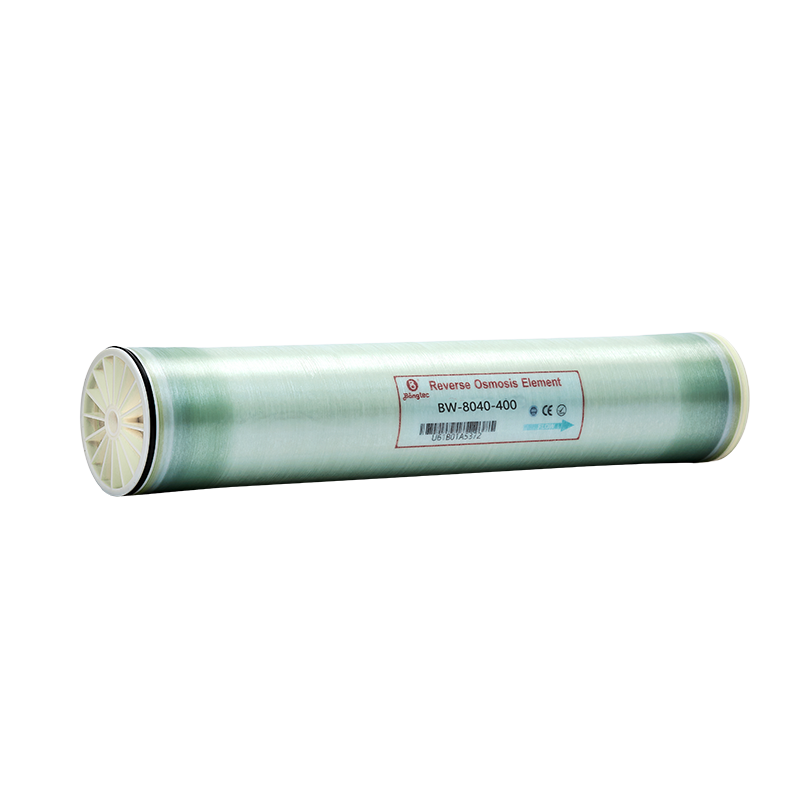 BW-8040-400 Brackish Water RO Membrane ElementFor inland brackish-water systems needing 400 ft² elements, this BW-8040-400 offers 99.7% stable rejection and 10,500 GPD permeate flow.View Product →
The mistake to avoid is choosing elements on rejection alone. A slight advantage that fades after six months of operation is worth less than an element that holds its normalized salt passage for three years.
Pump energy is the largest operating cost in an RO train, and it scales almost linearly with feed pressure. A standard brackish element in a two-stage array typically runs at 12 to 17 bar. An ultra-low-pressure element of the same 8040 footprint can hold several bar lower on comparable feed, which often translates into a 20 to 30 percent cut in high-pressure pumping energy across a year of continuous operation.
Temperature correction is where energy estimates go wrong. Membrane flux rises by roughly 3 percent per degree Celsius, so a plant designed at 25 °C needs more pressure or more elements when winter feed drops toward 10 °C. Design at the coldest expected feed temperature, then verify the summer case for permeate quality rather than the other way around.
Low-pressure elements have a boundary condition. Lower net driving pressure also means lower crossflow energy, and if concentrate flow per element falls below the manufacturer's minimum, concentration polarization and organic fouling accelerate. These elements suit low-TDS, well-pretreated feed; they are a poor fit for high-organic reclaimed water.
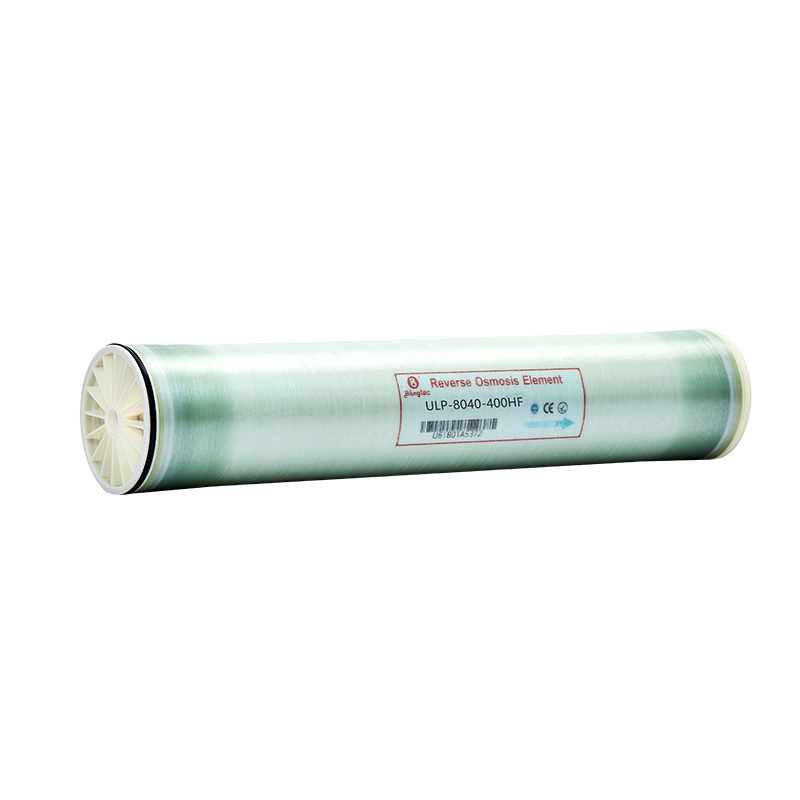 Ultra-Low Pressure RO Membrane Element ULP-8040-400HFFor low-salinity, well-pretreated feed, ULP-8040-400HF delivers 14,000 GPD permeate at 150 psi with 99% stable rejection.View Product →
Where feed chemistry is stable, the pressure saving is permanent. Where it is not, the saving is borrowed against membrane life.
Three failure modes dominate semiconductor RO systems, and each has a measurable early warning:
Fouling-resistant elements address the second problem with wider feed channels and a smoother, less charge-attractive surface. Flux design matters just as much: on wastewater-derived feed, holding 12 to 18 L/m²·h keeps fouling rates manageable, while pushing to 22 L/m²·h buys a smaller footprint at the cost of cleaning frequency and membrane life.
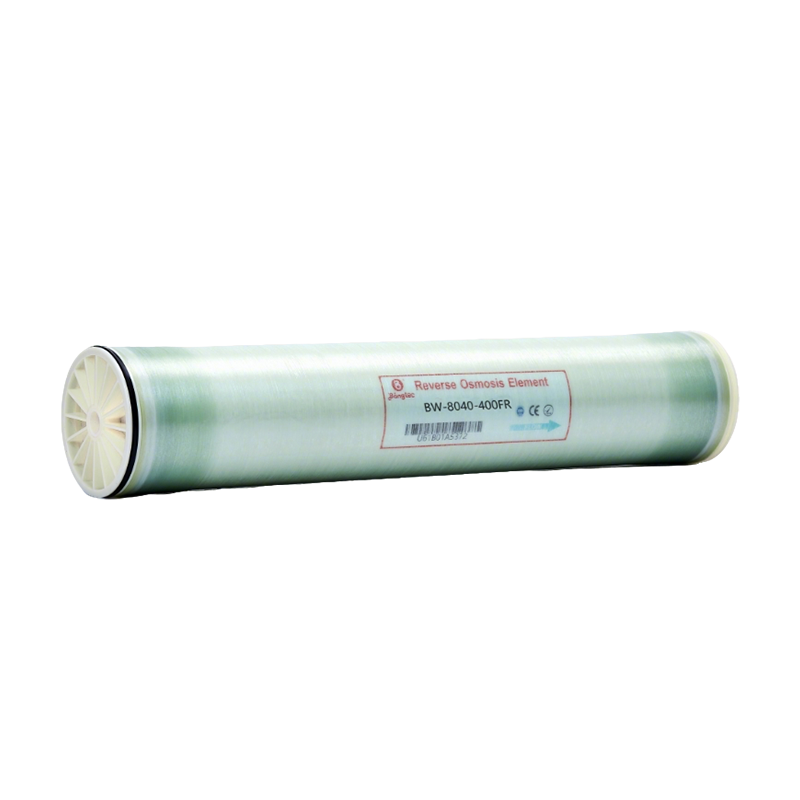 Fouling Resistant RO Membrane Element BW-8040-400FRFor complex or wastewater-derived feed, BW-8040-400FR combines fouling-resistant construction with 99.7% stable rejection and 10,500 GPD permeate flow.View Product →
A cleaning interval that stays stable across two years of normalized data is a better indicator of a correct selection than any single lab result.
Semiconductor plants qualify materials slowly for good reason: an element that passes the factory test sheet but varies lot to lot will surface months later as drifting EDI performance. Three things deserve attention during sourcing.
Bangtec, the brand of Jiangsu Tuobang Environmental Technology, sits in that category — a membrane manufacturer that also designs the systems around its elements, with more than 50 patents, a development team with backgrounds at GE and the Chinese Academy of Sciences, and ISO 9001 and CE credentials. More about the company is available on its profile page, and the site's guide to choosing an RO membrane walks through the selection checks in more detail.
Before committing a full array, pilot the actual feed for at least 3,000 hours or three to six months and judge it on normalized salt passage, normalized pressure drop, and normalized flux. Raw readings hide temperature and pressure effects and will let a declining element look healthy.
Elements in the 99.5 to 99.7 percent nominal range are standard. First-pass system rejection of 97 to 99 percent is typical, and a second pass pushes overall rejection above 99.9 percent, which is what EDI needs to stay within its resin capacity.
No. With low boron and silica in the raw water, a single pass plus EDI can work. Designs targeting boron below 0.1 ppb usually go double-pass or operate the first pass at elevated pH, because boric acid passes single-pass membranes too easily at neutral pH.
Three to five years is common with controlled pretreatment, reliable dechlorination, and disciplined cleaning. Replacement should be triggered by normalized performance — rising salt passage, climbing pressure drop, or more pressure needed for the same flux — not by a calendar date.
The membrane chemistry is largely the same thin-film composite polyamide. What differs is quality control, extractables, dimensional tolerance, and documentation. For UPW duty, ask for extractables data and lot traceability, not just the factory test sheet.
Bring four numbers to any RO purchase discussion: the complete feed water analysis, the coldest and warmest design temperatures, the boron and silica targets at the RO outlet, and the minimum concentrate flow per element. Those four determine the element family, the array staging, the pump pressure, and the cleaning interval.
Everything else — brand preference, price per element, lead time — is negotiable. Rejection that holds for three years is not.
Popular Products

+86-513 8659 8187
+86-189 6299 3952
No.28 Wenjing Road, Nangtong High-tech Industrial Development Zone, Jiangsu Province, China


 EN
 عربى