
Content
A 1,000 LPH brackish water reverse osmosis system fed at 2,500 mg/L TDS can hold permeate under 100 µS/cm for a decade, or miss that target within eighteen months. The difference is rarely the membrane brand. It is whether the feed was characterized, whether flux stayed inside a sane window, and whether pretreatment was sized for the worst week of the year instead of the best day of a pilot trial.
The short version: on brackish water, reverse osmosis is a fouling and recovery problem far more than a salinity problem. Osmotic pressure is modest, so pumps are small and energy is cheap. What actually kills these systems is colloidal and organic fouling, carbonate and sulfate scaling at the tail of the array, and temperature swings that move both flux and salt passage.
Brackish water is conventionally defined as 1,000–10,000 mg/L TDS, and most industrial skids work comfortably up to about 15,000 mg/L. Seawater sits near 35,000 mg/L. That gap changes the hardware class, not just the setpoints.
The lower pressure creates a consequence that catches people out. Because net driving pressure is small, errors in flux, temperature and pressure drop matter proportionally more. A brackish train running 15% over-fluxed in the first stage fouls visibly; a seawater train with the same relative error often does not.
A full water analysis costs less than one membrane replacement. If your feed data is a single TDS figure copied from a well log, sample properly instead, at design temperature and in the season of worst quality.
| Parameter | Typical brackish range | Design consequence |
|---|---|---|
| TDS | 1,000–10,000 mg/L | Sets osmotic pressure, pump class and element count |
| SDI15 | 3–6 untreated | Target ≤3, preferably ≤2.5, to protect lead elements |
| LSI at concentrate | +0.3 to +1.5 | Antiscalant dosing or acid addition; caps recovery |
| Silica | 10–30 mg/L | Concentrate limit near 120–150 mg/L at 25 °C |
| Temperature | 5–35 °C | Flux and salt passage shift; winter needs more pressure |
| Iron and manganese | 0.1–1.0 mg/L | Must reach the membrane below 0.05 mg/L |
| Free chlorine | 0.1–0.5 mg/L in municipal feed | Zero tolerance for polyamide; dechlorination required |
| Alkalinity and pH | pH 6.5–8.5 | Controls carbonate scaling and boron rejection |
Two numbers deserve extra attention. An SDI15 above 5 means pretreatment is not working, whatever the media filter datasheet claims. Free chlorine is fatal to thin-film composite membranes, which is why dechlorination sits upstream of the cartridge filters and why ORP is trended continuously rather than sampled weekly.
Most single-pass brackish systems run between 60% and 75% recovery. Around 65–70% is a comfortable default for well water; drop to 55–65% for surface water with higher fouling tendency. Recovery is not a free variable — it is capped by the least soluble salt in the concentrate and by silica.
Flux targets keep fouling in check. Clean well water tolerates 20–25 LMH (12–15 GFD); surface water and biologically active feed belong at 15–18 LMH. Staging is usually 2:1 for small trains and 3:2 or longer for large ones. Producing 50–100 µS/cm permeate from 2,000 mg/L feed requires roughly 97% salt rejection, comfortably inside standard brackish membrane performance — but only when the array is not starved of crossflow.
Standard brackish elements cover most industrial duty. Ultra-low-pressure variants cut pump energy where feed temperature is moderate and TDS sits at the lower end, at a small cost in salt passage. Fouling-resistant elements use a modified feed spacer and surface chemistry that tolerate higher organic loading, a sensible upgrade on surface water or any stream with measurable biological activity.
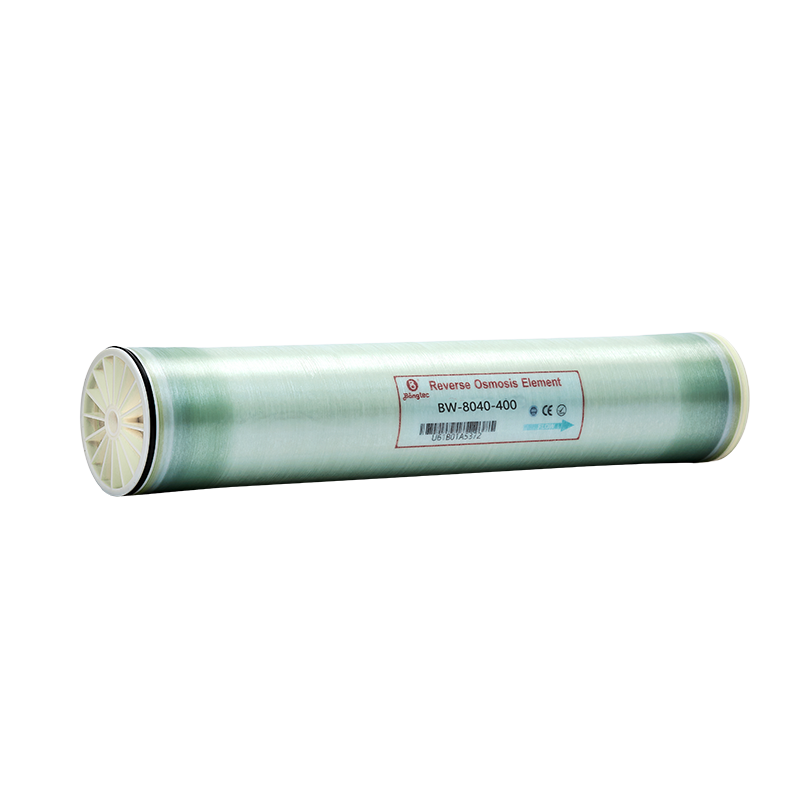 BW-8040-400 8-Inch Brackish Water RO Membrane ElementIndustrial spiral-wound element for brackish water and related sources, with 400 ft² area and specifications suited to standard high-rejection duty.View Product →
In the 8-inch class, the industrial brackish water RO membrane range covers standard high-rejection duty with nominal 400 ft² elements. Check the specification sheet against your own temperature case: an element rated at 25 °C test conditions needs noticeably more pressure at 10 °C, and that pressure must come from the pump curve rather than from optimism.
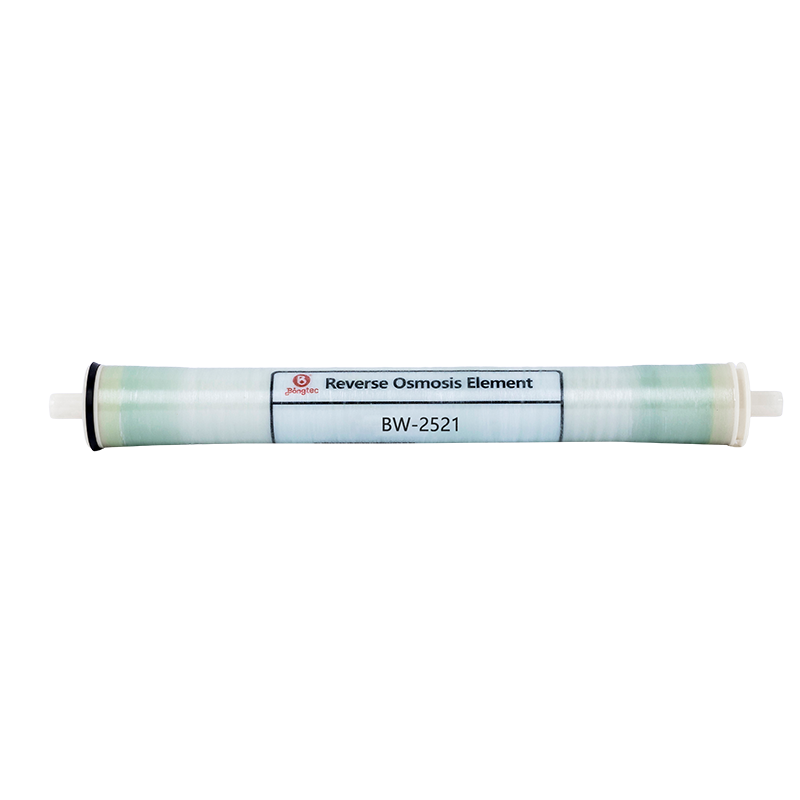
Not every brackish water reverse osmosis system is a 200 m³/h industrial rack. Pilots, containerized plants, resort and greenhouse irrigation lines and small bottling operations run on 4-inch or 2.5-inch elements. The design logic is identical; the constraints change to footprint, headroom and who performs maintenance.
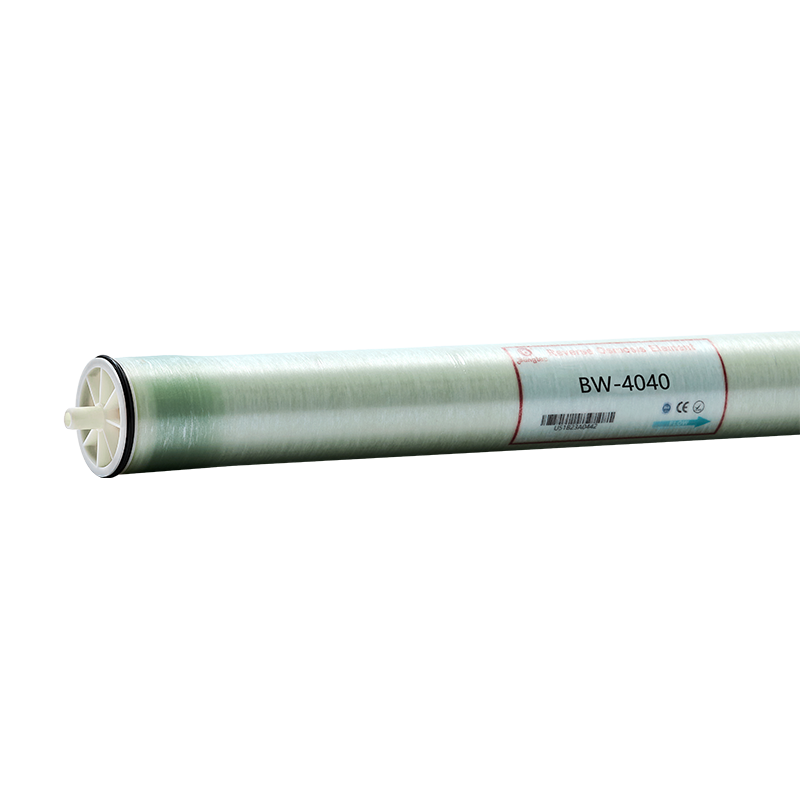 BW-4040 Commercial Brackish Water RO Membrane ElementCompact 4-inch element for commercial desalination and small treatment systems, balancing reliable water production with easier footprint and service.View Product →
Commercial skids usually trade a little efficiency for a smaller footprint and easier service. Compact housings can be serviced by one technician without lifting gear, which matters when the unit sits in a plant room rather than a dedicated water treatment building.
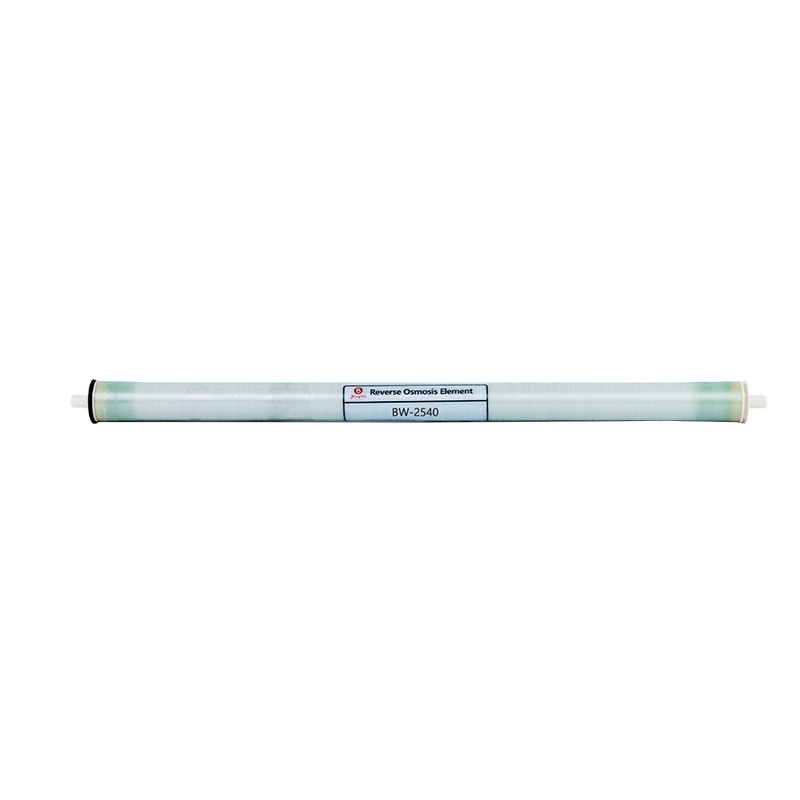 BW-2540 Commercial Brackish Water RO Membrane ElementSmall commercial element for high-TDS municipal, laboratory, medical, and compact onboard water treatment where limited footprint and simple maintenance matter.View Product →
Sizing still follows the same rules: keep flux below 18 LMH, hold recovery where concentrate chemistry allows, and never let chlorine reach the polyamide. Small systems fail for exactly the same reasons as large ones.
Brackish systems are usually under-instrumented. The minimum set that makes performance data meaningful:
Trend everything normalized to 25 °C. Raw readings drift with the seasons and hide fouling for months. Interlocks worth writing into the PLC specification include high differential pressure, low concentrate flow, high permeate conductivity, low suction pressure and high feed temperature.
Membrane life of three to seven years is realistic when cleaning is triggered by data rather than by the calendar. Standard triggers are a 10–15% drop in normalized permeate flow, a 10% rise in normalized salt passage, or a 15% increase in differential pressure across a stage.
Flush with permeate before any shutdown longer than a day. Replace cartridges on pressure drop, not on schedule. Confirm the antiscalant dose at the actual dosing point, because a failed dosing pump is the most common cause of sudden scaling — and match the cleaning chemical to the fouling type, since an alkaline cleaner will not remove calcium carbonate scale.
Ask for these items in writing. Vague proposals are the main source of later disputes.
Supplier depth matters here. A manufacturer that produces its own membrane sheets and elements controls the specification at the material level. Bangtec, for example, holds more than 50 patents with an R&D team drawn from GE and the Chinese Academy of Sciences, is ISO 9001 and CE certified, and runs over 15 million m² per year of automated membrane capacity. Reviewing the manufacturing and quality control process usually tells you more than a brochure.
Roughly 1,000–10,000 mg/L, extending to about 15,000 mg/L in many industrial designs. Above 20,000 mg/L the design moves toward seawater practice.
Typically 10–25 bar at the high-pressure pump, depending on TDS, temperature and recovery. Feed at 5–10 °C pushes the requirement toward the upper end.
Physically yes, practically rarely. Surface water carries more organics and biological load, so pretreatment and flux targets differ. Designing for the harder water usually oversizes pretreatment for the easier one.
Three to seven years on well-maintained industrial systems. Cleaning frequency, chlorine exposure and how reliably pretreatment holds SDI15 below 3 move that number most.
Popular Products



+86-513 8659 8187
+86-189 6299 3952
No.28 Wenjing Road, Nangtong High-tech Industrial Development Zone, Jiangsu Province, China


 EN
 عربى